Why this matters
The burden is measured in lives. The opportunity is prevention at the material layer.
An estimated 7.7 million deaths in 2019 were associated with 33 common bacterial pathogens—roughly 21,100 per day and 879 per hour. Neurovia does not claim one material can prevent that burden. It is building a platform for surfaces, fibers, filters, and protective systems where biological control may reduce exposure and transmission risk.
Conventional approach
Add function after manufacture.
Coatings, finishes, laminates, dispersed additives, and secondary treatments can add steps, suppliers, durability concerns, and application-specific failure modes.
Neurovia thesis
Design function into the material.
Preserve functional molecular behavior through production so existing manufacturing infrastructure can create functional material forms directly.
Two-path commercialization
Commercialize the nanofiber capability while de-risking the manufacturing platform.
The investment case is not dependent on waiting for one future melt-spinning milestone. Neurovia can pursue nanofiber applications from existing material work while the larger thermoplastic platform is validated.
PATH 01 · NEARER TERM
Nanofiber applications
Build from already-spun material forms and documented laboratory observations toward controlled prototypes, application testing, customer evaluation, and vertical-specific partnerships.
- Filtration and air-quality media
- Wound-contact and protective interfaces
- Specialty textiles and defense applications
- Paid development and co-development programs
Existing samples · application validation required
PATH 02 · PLATFORM SCALE
Thermoplastic manufacturing
Determine whether the functional state can survive PET melt processing and be transferred into continuous fiber, pellets, masterbatch, and other familiar industrial forms.
- Conventional extrusion and melt spinning
- Process windows and QC methods
- Pilot transfer to qualified manufacturers
- Field-specific licensing and royalties
NSF Phase I submitted · manufacturing risk under test
THE CATEGORY OPPORTUNITYIf function survives conventional manufacturing, PhantomFiber™ is not one product. It is a repeatable way to create classes of functional materials.
Evidence architecture
What has been observed. What remains to be proven.
The record is strongest when the historical evidence and the current manufacturing question are kept separate. Investors can evaluate both without confusing laboratory observations with commercial validation.
Observed record
Validation program
Evidence boundary: the reported R72 value was calculated at the assay detection limit and the investigator recommended repetition. The same result was not observed against P. aeruginosa. Commercial, medical, protective, and defense claims require application-specific testing, repeatability, durability, safety, and regulatory review.
Manufacturing program
Processing → structure → function → decision.
Phase I preserves samples and evidence at each stage so failure can be localized and corrected rather than hidden inside a binary outcome.
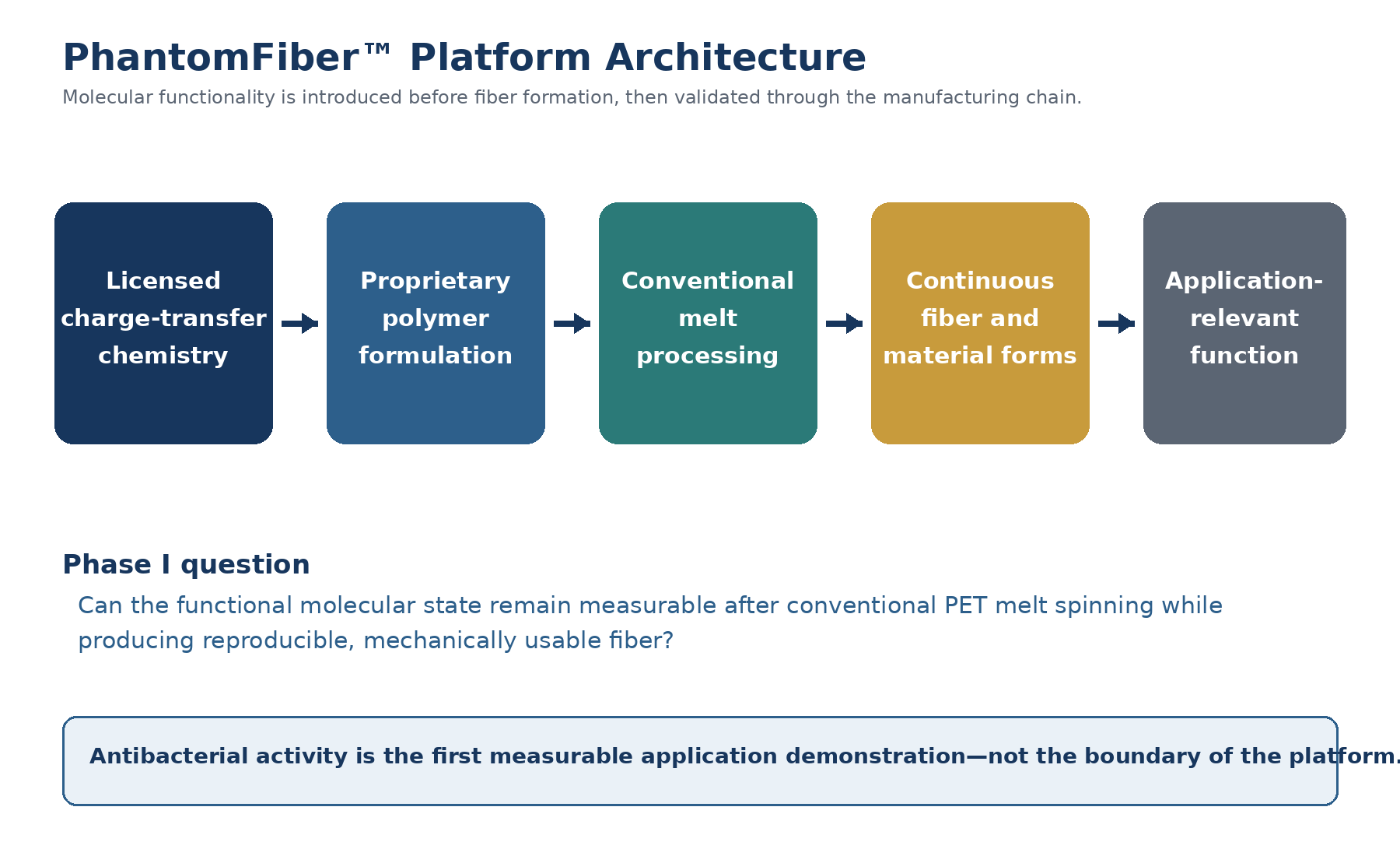
Licensed chemistry → proprietary formulation → conventional processing → functional material forms.
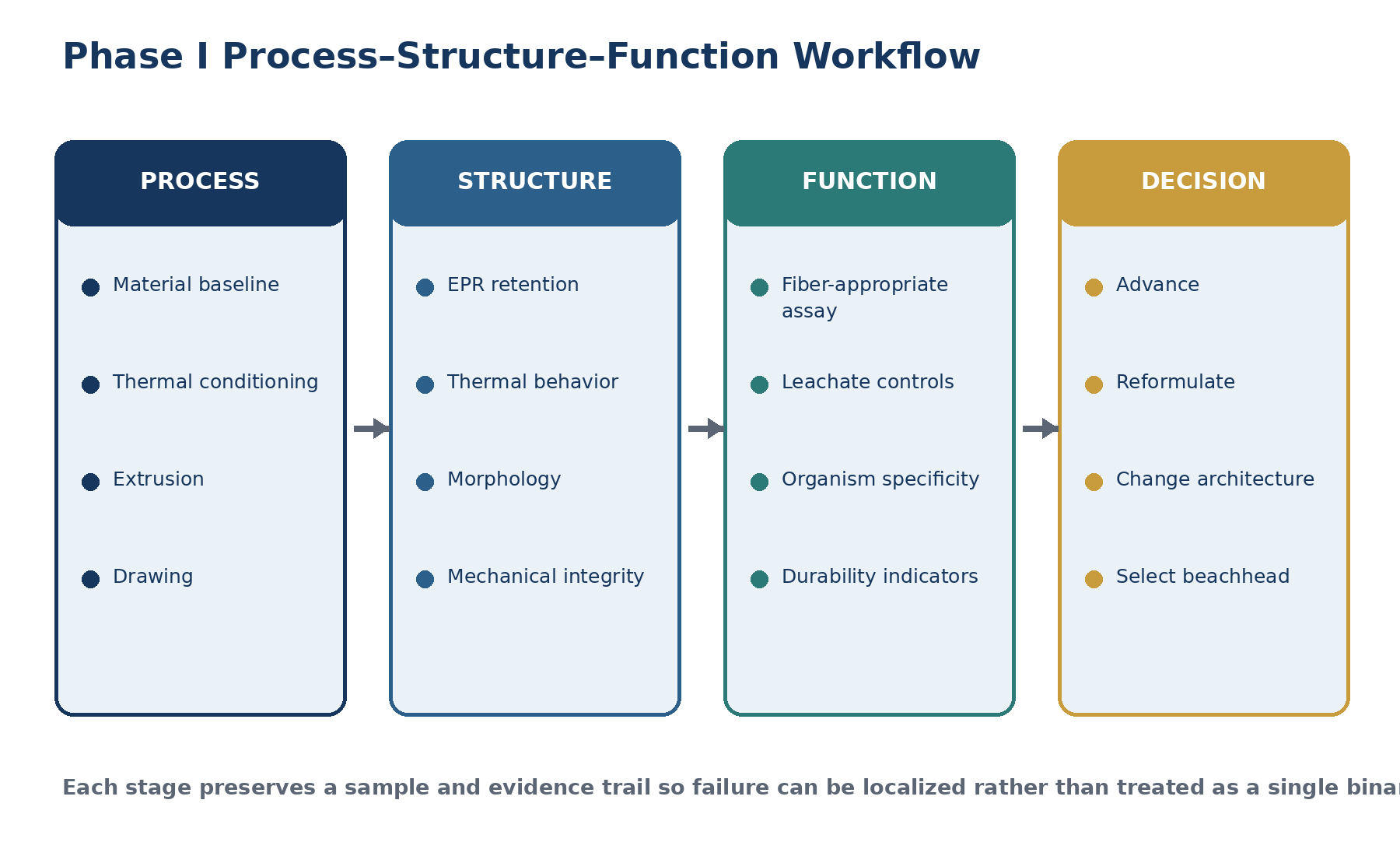
Stage-resolved manufacturing evidence.
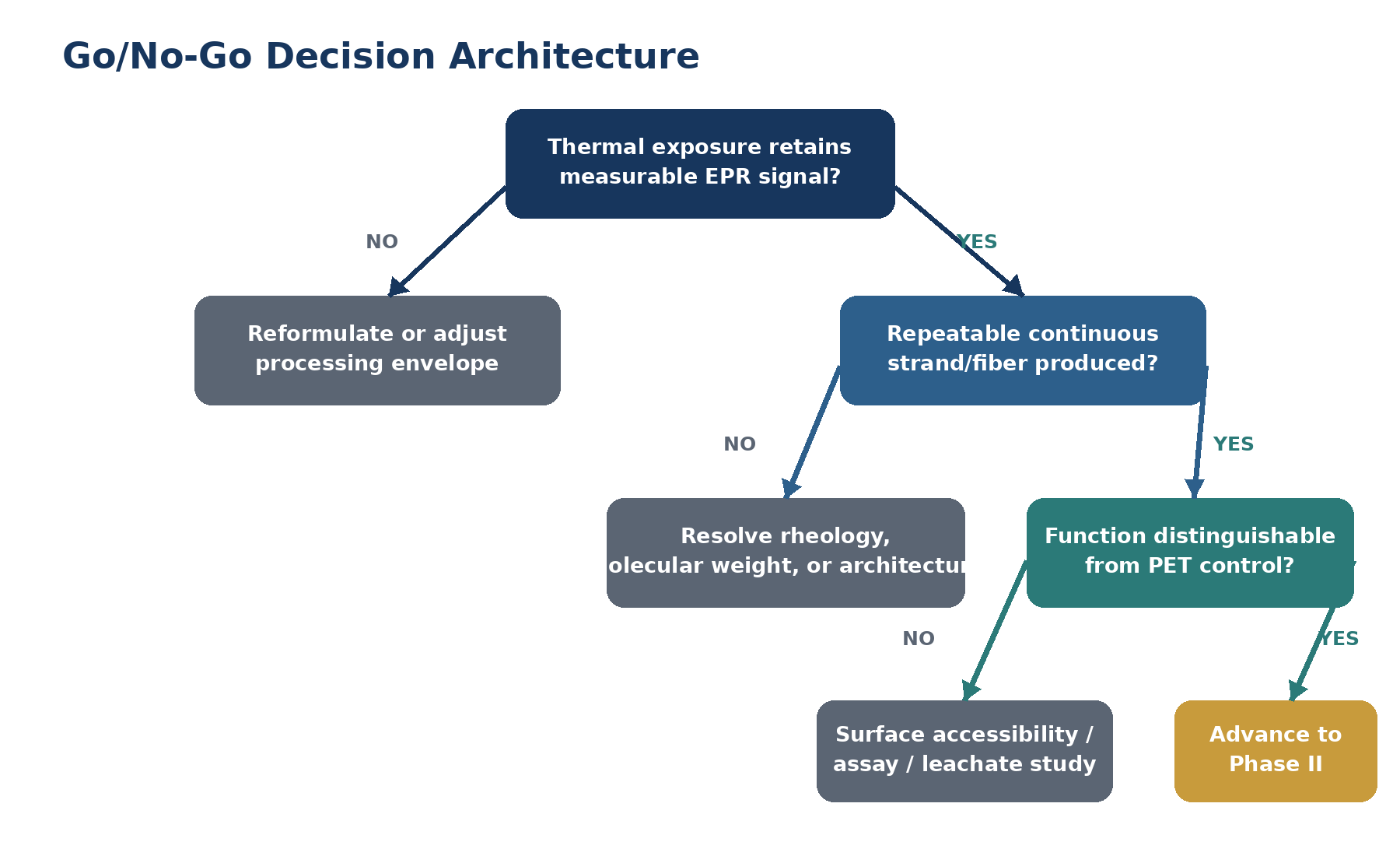
Defined continuation and redirection gates.
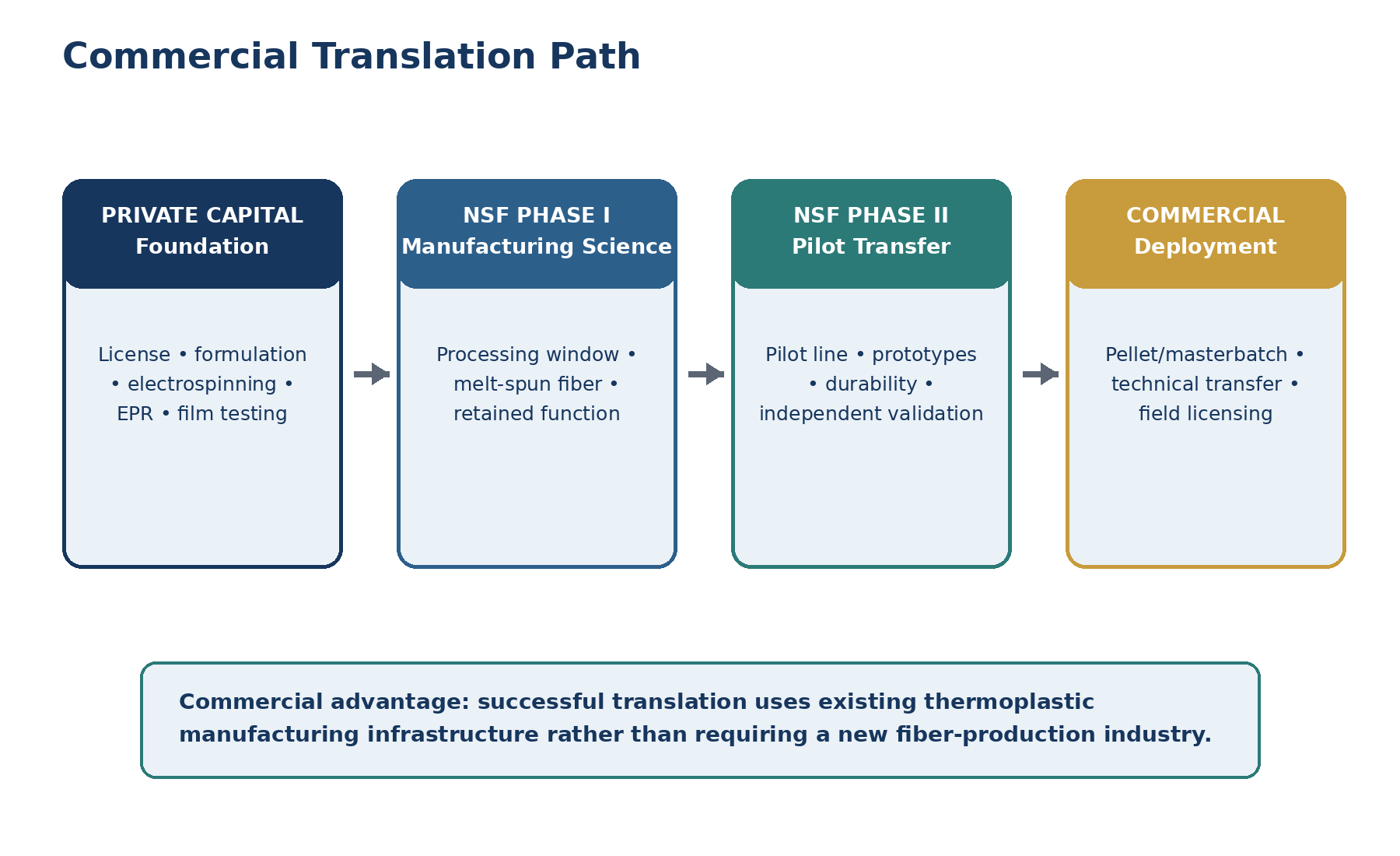
Private foundation → manufacturing science → pilot transfer → deployment.
How value compounds
A capital-light platform with multiple revenue layers.
Neurovia does not need to own a commodity-scale fiber plant. It can own the technology, process knowledge, evidence, quality controls, application data, and commercial rights that manufacturers need.
01Paid developmentApplication and partner-funded programs
→02Specialty material supplyNanofiber media, pellets, or masterbatch
→03Technical transferPilot specifications and QC methods
→04Licensing + royaltiesField-specific manufacturing economics
Moat 01
Licensed foundation
Defined rights to the underlying charge-transfer chemistry, governed by the executed agreement.
Moat 02
Proprietary know-how
Formulation classes, preparation practices, process windows, and failure-correction logic.
Moat 03
Evidence and QC
Stage-resolved data, analytical methods, repeatability criteria, and application validation.
Moat 04
Partner network
Scientific, manufacturing, commercial, and government pathways that shorten translation.
Investment opportunity
A proposed $7.5M financing to translate PhantomFiber™ evidence into repeatable manufacturing and commercial programs.
The current management financing position is $7.5 million for 10% of Neurovia Dynamics. This is a proposed transaction position—not an independent third-party valuation—and is presented so investors can evaluate the ask against the licensed foundation, observed record, manufacturing risk, application pathways, and milestones the capital is intended to buy.
$7.5MTarget primary capital raise
10%Proposed equity offered
$67.5M / $75MImplied pre-money / post-money valuation
Two pathsNear-term nanofiber + platform-scale thermoplastics
Why equity is available now
This is an acceleration round, not a survival round.
Neurovia Dynamics is offering equity while the company remains pre-revenue because outside capital can materially compress the path from established technical assets to commercial scale. The financing thesis does not assume a continuing sequence of equity rounds.
If commercialization produces sufficient operating cash flow, management’s preference is to fund subsequent growth from operations rather than continue selling ownership. Investors in this round are therefore evaluating an opportunity that management does not assume will remain available after meaningful commercial revenue is established.
What exists now
The financing builds from a bounded evidence and IP foundation.
- Licensed charge-transfer chemistry foundation and protected commercial rights
- Historical nanofiber and film observations preserved with explicit evidence boundaries
- Existing material work supporting application-specific development
- Defined thermoplastic manufacturing hypothesis and staged validation program
- Commercial pathways spanning paid development, material supply, technical transfer, licensing, and royalties
- Applied Defense pathway for mission-aligned government and defense engagement
What the capital buys
De-risk manufacturing while creating nearer-term commercial evidence.
- Repeatability, durability, safety, and application-specific validation
- Nanofiber prototypes and partner/customer evaluation programs
- Thermoplastic formulation, extrusion, melt-spinning, pellet/masterbatch, and QC development
- Independent laboratory and manufacturing evidence packages
- Technical transfer and qualified manufacturing partnerships
- Commercial, regulatory, IP, and working-capital capacity required for licensing and supply programs
Commercial milestones
The financing should create decision-grade evidence and revenue-bearing pathways.
- Paid application-development or co-development programs
- Repeatable application-specific performance under defined conditions
- Manufacturing go/no-go decisions supported by preserved process evidence
- Qualified pilot manufacturing and technical-transfer packages
- Material-supply, field-license, or royalty-bearing commercial agreements
- Clear separation of demonstrated properties from properties still under validation
Valuation discipline
The platform upside is large; the evidence boundary remains controlling.
The implied valuation is not represented as independently established. Investors should evaluate it against the licensed foundation, proprietary formulation/process know-how, observed biological record, manufacturing scalability, application breadth, partner access, commercial rights, and the value created if function survives familiar industrial processing.
Laboratory observations are not commercial validation. Revenue, customer commitments, manufacturing repeatability, regulatory status, and application performance should be represented only through verified schedules and preserved evidence.
THE INVESTOR QUESTIONCan $7.5M turn a bounded functional-material record into repeatable products, qualified manufacturing, and licensing economics without pretending the remaining science is already solved?
Public operational face
Neurovia Applied Defense
Because the current Neurovia Dynamics corporate page is outside Tim Zlomke’s control, Neurovia Applied Defense serves as the controlled public expression of mission-aligned material systems, government engagement, and operational applications.
NEUROVIA DYNAMICSScience · IP · Manufacturing Platform↓NEUROVIA APPLIED DEFENSEMission Applications · Government Engagement
Controlled diligence
Evaluate the evidence, rights, nanofiber path, and manufacturing upside.
Qualified investors and strategic partners may request access to controlled records. Exact formulations, license terms, unpublished methods, and partner-confidential materials remain protected.